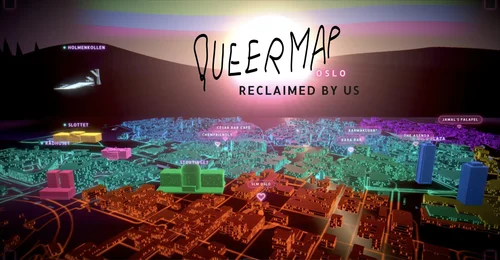
Queer Map: a safety map by and for queer people
Hi, I'm Frida Marida.
I'm a Lebanese-Norwegian trans woman living in central Oslo.
It started over a jar of pickles.
A few months ago there was a food bar near me where I started to feel at home. I went so often that the staff knew me. They knew I brought my own jar of Lebanese pickles to put in my sandwich, because that's how I made the food taste like the place I come from. That little jar was my way of making this neighbourhood feel like mine.
One day I walked in and they were gossiping about me, making fun of me, misgendering me. Loud enough that I heard every word. Quiet enough that they could deny it.
I tried to confront them. They refused to admit anything. There was no proof. There was no recording. There was nobody to tell.
That day I questioned everything. My gender. My choices. My expression. I felt I wasn't enough. I felt I didn't pass as a woman. The gender dysphoria hit me again.
This isn't just my story.
After that day I started telling friends which places were safe and which were not. Soon there was a WhatsApp group. Then another. Every trans and queer person in Oslo carries the same private map in their head: where I'm safe, where I'm not, which café is welcoming, which clinic uses my name, which neighbourhood to avoid after dark.
We build this map alone, every day. We pass it on by text and rumour.
Norway is one of the most progressive countries in the world. It's 2026. And we still live this.
Education alone isn't reaching everyone. Accountability might.
There are brilliant Norwegian organisations doing queer competency training, diversity workshops, awareness campaigns. But most businesses don't seek them out. The leaflet stays in the drawer.
Queer Map adds what education alone can't: consequences. A public rating a business can't ignore. A reputation they have to earn back.
Once businesses see they have a rating, they start asking how to improve it. That sends them to the queer organisations and trainers who have been doing this work for years. Queer Map becomes the pressure that finally fills the workshops, the certification programmes, the queer-competency consultancies. We help the community get safer AND we help the people building queer-safety work get in touch with their target.
What Queer Map does.
A free mobile and web app where queer and trans people rate places from -2 (hostile / dangerous) to +5 (explicitly queer-affirming). Cafés. Restaurants. Bars. Clinics. Government offices. Workplaces. Neighbourhoods.
Safe places light up in colour. Hostile places carry a warning marker. One glance tells you where you can breathe.
You add a rating. You leave a review. Anonymously, if you need to. The next person who walks past that food bar knows what to expect.
One bad experience becomes a warning that protects the next person. One welcoming place becomes a lighthouse.
Pride is not one month.
We don't want to feel safe only when the rainbow flags come out. We need it on a Tuesday in November. At a clinic appointment. Ordering a coffee. At a job interview.
Pride is a celebration. Queer Map is the infrastructure underneath, for the other 11 months.
The risks we name openly.
- Harassment. A -2 rating could be weaponised against queer-owned businesses by anti-trans groups. Moderation is built from day one. No system is perfect.
- User safety. Reviewers reveal themselves as queer when they contribute. Anonymity, location fuzzing, data minimisation and threat modelling are core, not afterthoughts.
- Sustainability. Apps die when funding ends. Phase 1 covers build and six months of operations. Phase 2 onward is funded by certification partnerships and verified business subscriptions. Never ads. Never data sales. Never sharing data with hostile governments.
Principles we cannot break.
- Free for queer users. Always.
- Businesses can pay to prove themselves, have their logos on the map and have the possibility to reacte to comments and show willingness ... No one ever pays to influence what the community says.
- No sponsored markers. No removal of negative reviews. No selling user data.
- Never sharing data with governments that criminalise queer people.
Partners.
Queer Map's aim is to become the professional, community-built database that the wider queer ecosystem can use as a shared reference. Educators, trainers, queer-competency programmes, certification bodies and queer-rights organisations are already doing crucial work. What is missing is the connective tissue: a public, community-owned record of which businesses need attention, which have done the work, and which keep showing up for us. Queer Map exists to be that record, and to direct people and resources to where they are needed.
Why now.
Because every queer person already carries this map in their head.
Because we deserve to share the burden instead of carrying it alone.
Because the food bar where I was misgendered will keep doing it until someone tells the next person ... and by the way, they still have my jar of pickles.
And because the world is moving in the wrong direction. Right-wing movements across countries, schools and businesses are quietly stripping queer flags and symbols off the websites, walls and storefronts that used to fly them. Our public presence is shrinking. Years of slow progress are being rolled back month by month. We have to reclaim the places we won, before that progress disappears. Queer Map makes that work visible, measurable, and impossible to erase quietly.
You give. We build. The community uses it. The whole queer-safety ecosystem in Norway gets stronger.
Whether you're queer, trans, an ally, or an organisation working on queer rights, your support makes this real.
This is harm reduction infrastructure. This is civic technology. This is the queer community making the city safer for itself.
Check Queermap.app
take an idea :)
Happy Pride